
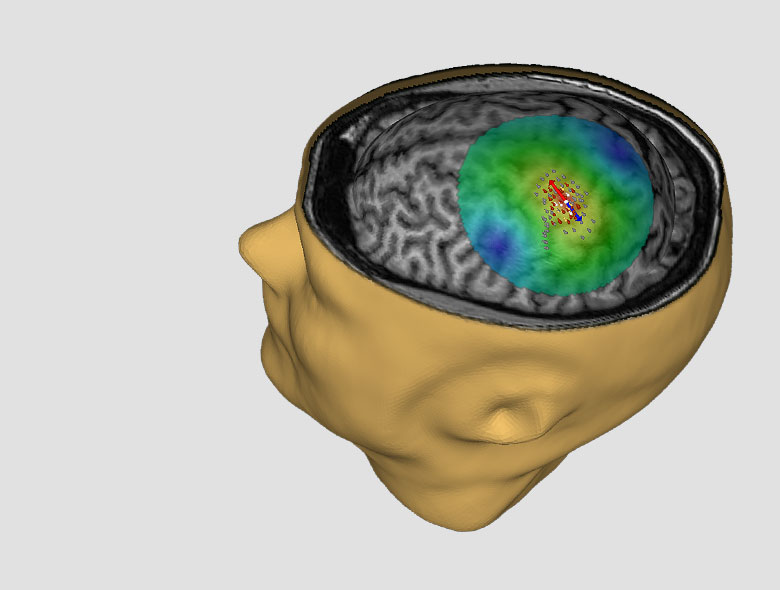
Reported benefits of Nexstim nTMS in a multicenter study:
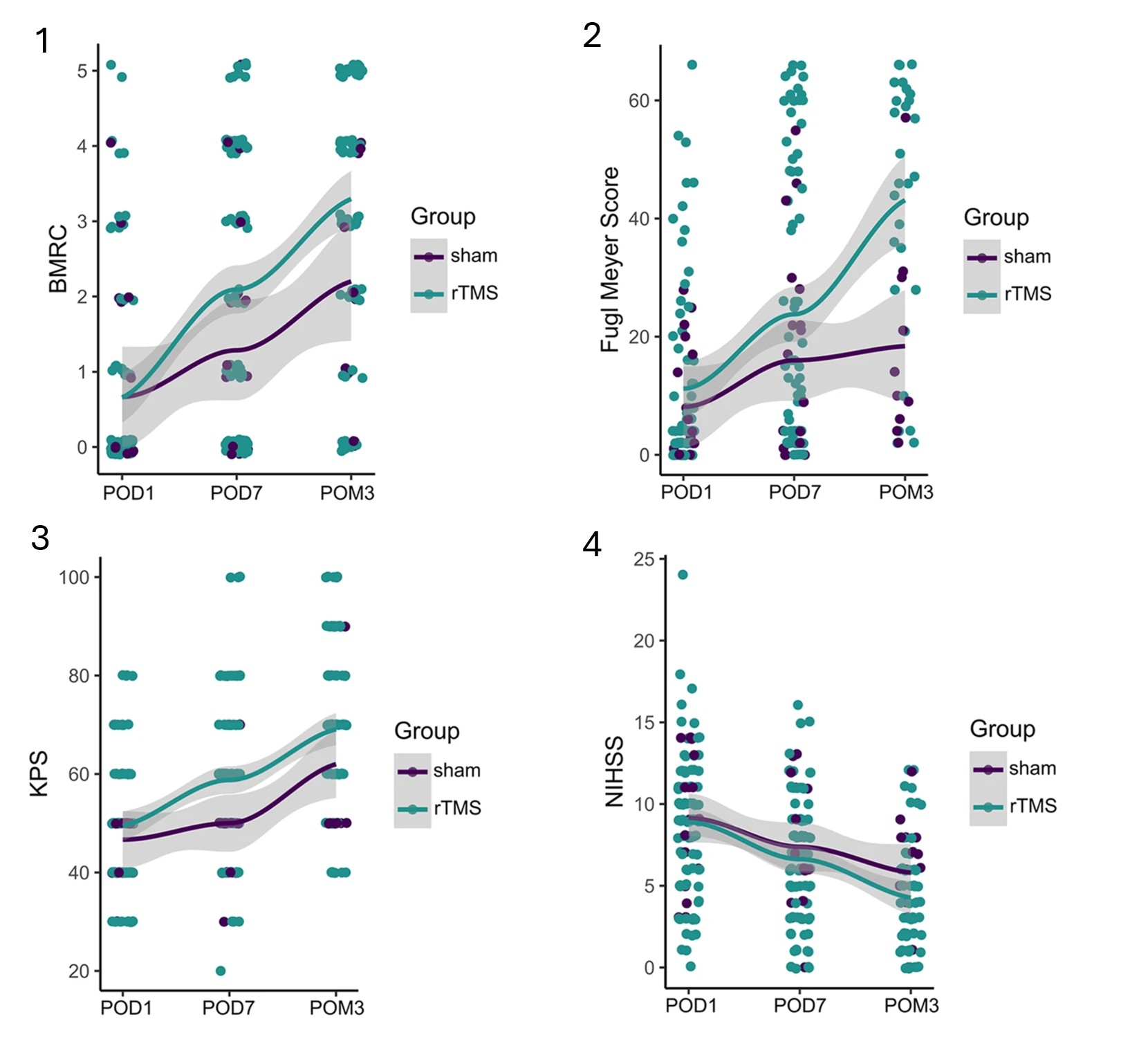
A total of 135 patients from four hospitals were included, of whom 51 patients were treated in RCTs (30 treatment group, 21 sham group) and 84 in prospective, single-arm studies. Patients underwent either low frequency contralesional nrTMS or sham stimulation followed by physiotherapy. Their outcome was assessed on postoperative day 1, 7, and after 3 months.
Results showed Nexstim navigated rTMS led to improvement in upper limb function:
- British Medical Research Council (7 days: OR 3.28; 95%CI: 1.08–9.99; 3 months: OR 2.03, 95%CI: 0.65–6.39)
- Karnofsky Performance Scale (7 days: mean difference (MD) 11, 95%CI: 2–19; 3 months: MD 11, 95%CI: 2–20)
- Fugl-Meyer assessment (7 days: MD 0.28, 95%CI: -0.34-0.9; 3 months: MD 0.14, 95%CI: -0.52-0.81)
- Also, researchers report a stronger treatment effect for patients with proven ischemia on the postoperative MRI.
According to researchers, this multicenter data confirms the positive treatment effect of navigated rTMS to reduce transcallosal inhibition with a considerably low NNT - especially in patients with proven ischemia on the postoperative MRI.1,2
How nTMS for post-operative rehabilitation can benefit your patients:
Even if a deficit occurs, neither you as a surgeon nor your patients are without options.
Prof. Dr. Sandro Krieg, MBA, Chair of Neurosurgery
Heidelberg University Hospital, Germany.
Learn more from our nTMS user community:
Hear from experienced clinicians, how they utilize navigated low-frequency rTMS for post-operative rehabilitation.
- Learn which stimulation parameters and protocols they use
- Find out how they combined rTMS with physical therapy for optimal results
- See real case examples of patients benefiting from rTMS treatment after post-surgical paresis
Yes, I would like to know more
Interested in a live demo of nTMS?
Our team of physicians, researchers, and engineers is prepared to answer your questions. If you would like to learn more or set up a virtual demonstration for your team, please contact us at info@nexstim.com
References
1 Ille, S. et al. Navigated repetitive transcranial magnetic stimulation improves the outcome of postsurgical paresis in glioma patients: a randomized, double-blinded trial. Brain Stimul. 14, 780–787 (2021).
2 Rosenstock, T. et al. Improving postsurgical paresis in brain tumor patients by transcranial magnetic stimulation. J. Neurooncol. 172, 417–428 (2025).
3 Hallett, M. Transcranial magnetic stimulation: a primer. Neuron 55, 187–199 (2007).
4 Hummel, F. C. & Cohen, L. G. Non-invasive brain stimulation: a new strategy to improve neurorehabilitation after stroke? Lancet Neurol. 5, 708–712 (2006).
Regulatory Approval
Nexstim is a medical device manufacturer. Nexstim NBS 6 is an FDA-cleared and CE-marked medical device (notified body number: 0537). For more information on individual regional clearances, please refer to the table, intended purpose and indications for use descriptions below:
| Clinical Application | European Union (CE mark) | United States (FDA) |
| Pre‑procedural Mapping | CE‑marked | FDA cleared |
| Post‑operative Motor Rehabilitation | CE‑marked | Investigational use only |
| Major Depressive Disorder (Adults) | CE‑marked | FDA cleared |
| Major Depressive Disorder (Adolescents) | Not CE‑marked | FDA cleared |
| Obsessive‑Compulsive Disorder | Not CE‑marked | FDA cleared |
| Chronic Neuropathic Pain | CE‑marked | Investigational use only |
Indications for use & Intended purpose
Pre-procedural mapping (CE mark, FDA clearance, for information on other regional clearances contact Nexstim):
Intended purpose: NBS 6 is intended to be used for localization and assessment of the motor cortex and motor tract integrity for pre-procedural planning purposes. NBS 6 is intended to be used for localization and assessment of cortical areas of speech function for pre-procedural planning purposes.
Indications for use: NBS 6 is indicated for noninvasive mapping of the primary motor cortex of the brain to its cortical gyrus. NBS 6 provides information that may be used in the assessment of the primary motor cortex for pre-procedural planning. NBS 6 is indicated for noninvasive localizations of cortical areas that do not contain essential speech function. NBS 6 provides information that may be used in pre-surgical planning in patients undergoing brain surgery. Intraoperatively, the localization information provided by NBS 6 is intended to be verified by direct cortical stimulation. NBS 6 is not intended to be used during a surgical procedure. NBS 6 is intended to be used by trained clinical professionals.
Post-operative Rehabilitation (CE mark, for information on other regional clearances contact Nexstim):
Intended purpose: NBS 6 is intended to be used for the treatment of surgically induced new or worsening post-operative motor deficits of the upper limb as an adjunct therapy for motor rehabilitation in adult patients having undergone brain tumor surgery. NBS 6 is intended to be used by trained clinical professionals.
Nexstim NBS 6 is not cleared by the FDA for commercial use of post-operative rehabilitation in the United States, for investigational use only.
Chronic Neuropathic Pain (CE mark, for information on other regional clearances contact Nexstim):
Intended purpose: In adult patients suffering from chronic unilateral neuropathic pain, NBS 6 is intended to provide electric field navigated noninvasive repetitive TMS stimulation as therapy to alleviate pain. NBS 6 is intended to be used by trained clinical professionals.
Indications for use: NBS 6 is indicated for MRI-guided and electric field (or E-field) navigated, noninvasive repetitive TMS stimulation (rTMS) of the motor cortex as therapy to alleviate chronic unilateral neuropathic pain in adult patients. Nexstim NBS 6 is intended to be used by trained clinical professionals.
Nexstim NBS 6 is not cleared by the FDA for commercial use of the treatment of chronic pain in the United States, for investigational use only.
Major Depressive Disorder (CE mark, FDA clearance, for information on other regional clearances contact Nexstim):
Intended purpose: NBS 6 is intended to be used for treatment of major depressive disorder (MDD) by targeting and delivering noninvasive repetitive TMS stimulation to the patient's dorsolateral prefrontal cortex.
Indications for use: NBS 6 is indicated for the treatment of Major Depressive Disorder in adult patients who have failed to achieve satisfactory improvement from prior antidepressant medication in the current episode. NBS 6 is intended to be use by trained clinical professionals.
Adolescent Major Depressive Disorder (FDA clearance, for information on other regional clearances contact Nexstim):
Indications for use: NBS 6 is indicated as an adjunct for the treatment of MDD in adolescent patients (age 15-21).
Obsessive-Compulsive Disorder (FDA clearance, for information on other regional clearances contact Nexstim):
Indications for use: NBS 6 is indicated as an adjunct for the treatment of adult patients suffering from obsessive-compulsive disorder (OCD).